Last UpdatedAug 14th, 2026•19 min read
Therapy Goal Setting That Actually Helps
Author

Samantha Hill
LCSW
If you’ve decided to start therapy (or start your search for a therapist), congratulations — you’ve taken an important first step. The next thing to think about? Therapy goals.
Therapy goals are the specific changes you want to work toward in therapy, such as reducing a symptom, building a skill, or improving a relationship. Good therapy goals are set collaboratively with your therapist, are specific enough to track, and are revisited and adjusted as you progress.
This blog will help you learn about the importance of therapy goals, why you don’t need to have one in mind when you first start therapy, how to set good goals, how progress toward your goals is measured, and more.
At-a-Glance: Therapy Goals
What they are
The specific changes you work toward in therapy
Set how
Collaboratively with your therapist
Good goals are
Specific enough to track, and often framed as SMART (Specific, Measurable, Achievable, Relevant, Time-bound)
Types
Symptom reduction, skill building, relationship improvement, and improving daily functioning
Short vs long-term
Near-term steps that build toward bigger changes
How progress is tracked
Measurement-based care: validated check-ins and reflection over time
Do they change?
Yes; goals evolve and are reassessed, which is normal
At Octave
Measurement-based care; fully licensed therapists; avg $28/session through insurance
Why therapy goals matter
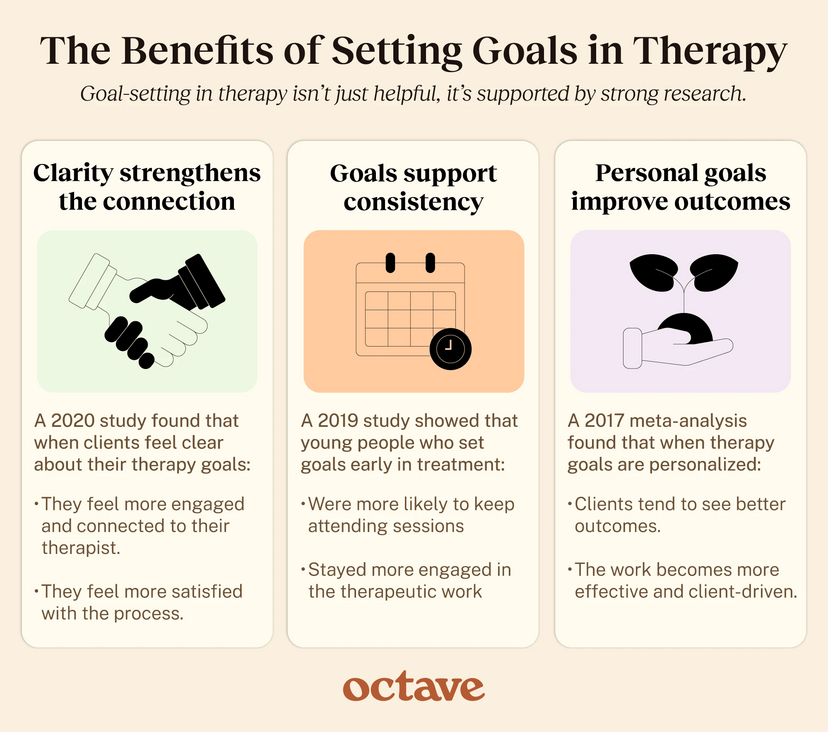
We don’t set therapy goals just for the sake of it. We set these goals to provide us with direction, motivation, and a way to measure progress.
Here are some tips for setting treatment goals that make a difference.
How to set therapy goals: A step-by-step approach
You can move from a vague sense of what you work on to having a more concrete goal in mind.
Here are some step-by-step tips for setting therapy goals. Remember, therapy is a collaboration, and your therapist will help you create your goals. You don’t need to come up with them on your own.
- Identify what brought you in: What made you seek therapy in the first place? Think about what aspect of your life you’d really like to improve.
- Pick a focus area: Even if you came to therapy for a variety of reasons, you might want to hone in on one first. Working on one goal at a time can feel more achievable.
- Shape a specific goal and make it SMART: Specific goals are often better since they point you in a clearer direction than broad goals. Make it a SMART goal, meaning it is Specific, Measurable, Achievable, Relevant, and Time-bound.
- Agree with your therapist on how you will track it: Tracking goals is key to make sure you’re on the right track. Decide with your therapist how you will track your progress and how often you’ll check in about that (i.e. once a week? Once a month?)
SMART therapy goals (with examples)
SMART goals are Specific, Measurable, Achievable, Relevant, and Time-bound.This makes your therapy goals easier to track.
While it might feel like a lot to identify and solidify all of these aspects, SMART goals are tools that ultimately serve you — they aren’t a rigid checklist to adhere to.
Let’s dive into each aspect:
- Specific: It clearly outlines what you want to work on.
- Measurable: There’s a concrete way to measure progress
- Achievable: It feels doable and realistic, not out of reach to get started.
- Relevant: It connects to what’s going on in your life right now.
- Time-bound: It has a timeframe so you can evaluate progress and stay motivated to make the progress within that timeframe.
Examples of Therapy Goals You Can Set
Therapy goals offer structure, direction, and space for growth at a pace that honors where you are and where you want to go. They support the process without trying to control it.
Some goals focus on symptom relief or daily functioning. Others support personal growth, emotional regulation, or healing from past experiences. Goals can also center around developing new, supportive behaviors or reducing unhelpful behavior patterns.
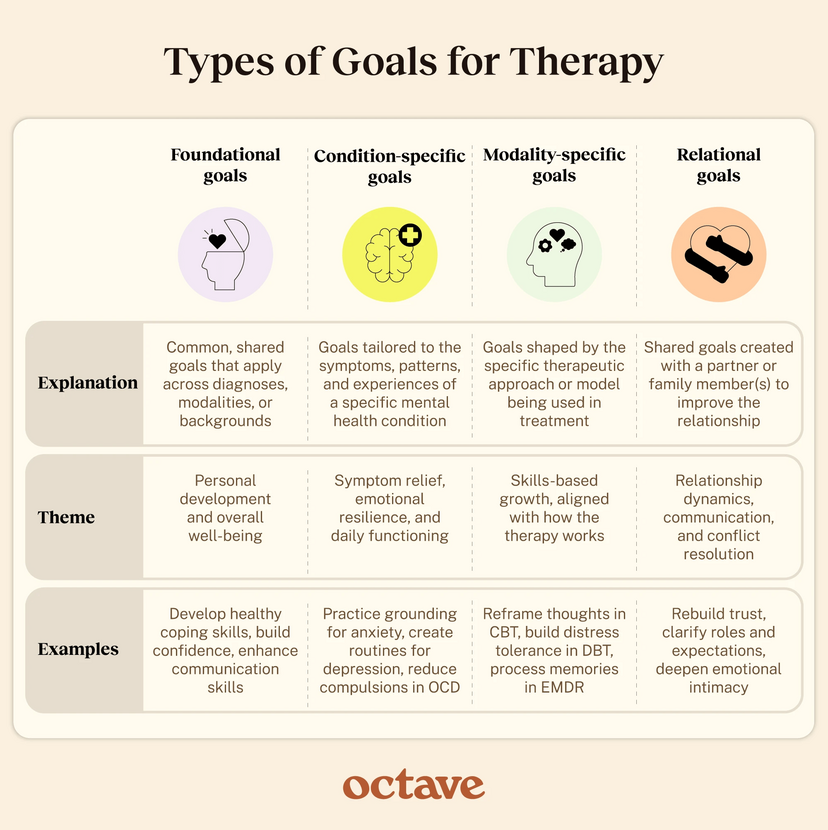
To help you imagine what this might look like, we’ve pulled together a few different types of goals and examples that you and your therapist might build on together.
Foundational therapy goals
Foundational goals are common goals that many people explore in therapy, regardless of diagnosis, therapeutic approach, or background. They tend to focus on emotional and mental well-being, personal development, and everyday challenges that impact mental health. They can also be especially helpful during life transitions or periods of adjustment, when things feel uncertain or out of sync.
These goals are a powerful starting point, especially if you’re new to therapy or unsure where to begin. And over time, they often lead into deeper, more specific work as patterns become clearer and needs evolve.
Here are some examples of foundational goals:
- Improve emotional regulation. Learn to identify, tolerate, and express emotions in a healthy and productive way, rather than feeling controlled by them.
- Build self-esteem and confidence. Address inner criticism, shift unhelpful beliefs, and develop a more supportive and balanced self-image.
- Develop healthy coping skills. Identify tools and techniques that help you manage distress, anxiety, or overwhelm without relying on avoidance or numbing.
- Enhance communication skills. Learn to express your needs, set boundaries, and navigate difficult conversations more effectively in friendships, romantic relationships, or with family.
- Increase self-awareness. Understand the emotional patterns, triggers, and life experiences that influence how you think, feel, and respond.
- Make value-aligned decisions. Clarify what matters most to you and commit to making more intentional, fulfilling choices based on those priorities.
These goals may seem simple, but they often lay the groundwork for deeper emotional insight and lasting change. Whether you stay focused on these foundational areas or use them as a springboard into more specific work, they can help you build greater awareness, resilience, and alignment in your everyday life.
Therapy goals for specific mental health conditions
When you’re navigating a specific diagnosis like anxiety, depression, OCD, or bipolar disorder, your therapy goals can be tailored to meet the unique symptoms, triggers, and experiences that come with it. These goals focus on symptom relief, emotional resilience, and strategies for daily life that support long-term healing and stability.
We’ve provided a few examples of how therapy goals can look when they’re aligned with specific mental health conditions.
For anxiety:
- Recognize and manage triggers. Identify situations or thoughts that activate anxiety and build skills to challenge those thoughts and respond with greater calm and control.
- Reduce avoidance behaviors. Work toward facing feared situations or tasks to reduce anxiety’s control over your life and prove that you’re stronger than your fears.
- Practice grounding techniques. Learn and regularly use strategies like deep breathing, progressive muscle relaxation techniques, or mindfulness to stay centered when anxiety rises.
For depression:
- Establish structure and routine. Reintroduce consistency with small habits, such as getting out of bed at the same time or preparing simple meals, to help counter low energy and motivation.
- Increase engagement in meaningful activities. Identify small actions (like walking outside, journaling, or calling a friend) that bring a sense of purpose or enjoyment and intentionally build them into your day, even when it feels extra hard to engage.
- Challenge self-critical thought patterns. Practice identifying and reframing negative inner dialogue to develop a more compassionate and balanced internal voice to boost your self-esteem.
For trauma or post-traumatic stress disorder:
- Build a foundation of emotional and physical safety. Identify what helps you feel grounded and supported, and incorporate those elements into your sessions and daily life.
- Learn to recognize and respond to triggers. Develop awareness of the cues that lead to emotional flashbacks or shutdowns, and use calming strategies to regain control in the moment.
- Process and integrate past events with care and support. Work with your therapist to explore past trauma, using techniques to reduce its emotional charge and reclaim your narrative.
For obsessive-compulsive disorder:
- Reduce compulsive behaviors. Practice tolerating obsessive thoughts without engaging in rituals in collaboration with your therapist.
- Change your relationship with intrusive thoughts. Instead of viewing them as facts, learn to see them as simply just thoughts that can come and go, knowing that you don’t need to feed into them.
- Increase tolerance for distress and uncertainty. Develop emotional tools to sit with discomfort and uncertainty, rather than trying to neutralize or avoid it.
For bipolar disorder:
- Create a consistent sleep and activity schedule. Establish daily routines that support mood stability, including sleep hygiene, meal timing, and exercise.
- Build early recognition of mood shifts. Learn to identify signs of mania or depression before they escalate and respond proactively.
- Develop a support plan for challenging moments. Collaborate with your provider to outline what to do and who to contact if symptoms escalate, including grounding tools and safety supports.
While these examples are grounded in specific conditions, your experience is always more than a diagnosis. The most meaningful goals reflect how those symptoms show up in your life and what support looks like for you. Your therapist can help tailor each goal so it feels manageable, flexible, and aligned with your needs.
Therapy goals based on your treatment approach
Different types of therapy offer unique tools, and your goals may reflect the focus of the specific modality you’re working with, such as DBT vs. CBT. These treatment goals are often skill-based and structured around how the therapy itself works.
In cognitive behavioral therapy (CBT), for example, your goals might center around identifying and shifting thought patterns. In dialectical behavior therapy (DBT), you might focus on building distress tolerance or emotional regulation skills. And in EMDR, your goals may include processing memories in a safe and supported way.
These examples show how therapy goals might look when they’re aligned to a specific modality.
In cognitive behavioral therapy (CBT):
- Identify and reframe cognitive distortions. Learn to catch unhelpful thoughts when they pop up and shift them into more realistic, empowering beliefs.
- Track emotional and behavioral patterns. Use worksheets or journaling to better understand how thoughts, emotions, and behaviors interact.
- Practice behavioral activation. Reconnect with rewarding or meaningful activities as a way to lift mood and counteract avoidance.
In dialectical behavior therapy (DBT):
- Strengthen emotional regulation and distress tolerance. Build skills to manage intense emotions without impulsive reactions, self-harm, or lashing out at others.
- Improve interpersonal effectiveness. Learn how to ask for what you need, say no, set boundaries, and manage conflict without damaging relationships.
- Integrate mindfulness into daily life. Increase your ability to stay present and grounded, especially during high-stress moments.
In acceptance and commitment therapy (ACT):
- Clarify personal values. Explore what really matters to you and let those values guide your decisions and goals as you move through life.
- Increase psychological flexibility. Build the capacity to stay open and adaptive in the face of discomfort, rather than resisting or avoiding unpleasant emotions.
- Practice acceptance of difficult emotions. Learn how to make space for discomfort while still moving toward what’s meaningful and valuable to you.
In eye movement desensitization and reprocessing (EMDR) therapy:
- Reduce the emotional intensity of traumatic memories. Use bilateral stimulation to process past events in a way that makes them feel less distressing or overwhelming.
- Challenge negative core beliefs linked to trauma. Replace beliefs like “I’m not safe” or “I’m to blame” with more adaptive, compassionate self-understandings that become the new norm.
- Strengthen internal resources for safety and resilience. Establish calming mental images through visualization, grounding tools, and breathing exercises to help you stay regulated during processing.
In mindfulness-based therapy:
- Develop present-moment awareness. Practice noticing thoughts, sensations, and feelings without judgment, using techniques like breathwork or body scans.
- Practice responding rather than reacting to emotional triggers. Create space between stimulus and response so you can actively choose how to act instead of being swept up in automatic, impulsive patterns.
- Foster greater self-compassion and acceptance. Use mindfulness to shift from self-judgment to self-kindness, especially during moments of difficulty or discomfort.
No matter the approach, your therapist will help you translate what you’re working on into goals that feel grounded, manageable, and relevant to your life.
Therapy goals for couples and families
In relational therapy (whether with a partner, family member, or loved one) the focus shifts from the individual to the relationship itself. The goal is to improve communication, repair connections, and shift unhealthy dynamics between people.
Goals in couples and family therapy are often co-created between partners or family members. At their best, these goals reflect both the needs of each individual and the dynamic of the relationship. They’re not about assigning blame or fixing one person, they’re about building stronger, more compassionate ways of being with each other.
These examples reflect how goals might be shaped based on relationship dynamics.
For couples:
- Improve communication and conflict resolution. Learn how to talk and listen in ways that foster connection and reduce misunderstandings.
- Rebuild trust after rupture or betrayal. Create a safe, structured space to explore pain points and begin repairing emotional injuries that might have happened due to an affair.
- Deepen emotional intimacy. Strengthen your bond through vulnerability, empathy, and shared understanding. This might also lead to deeper physical intimacy.
For families:
- Clarify roles and expectations. Reduce tension by creating shared language around responsibilities, boundaries, and needs.
- Foster healthier family dynamics. Address patterns like blame, silence, or enmeshment and replace them with more balanced connection where all family members feel heard and respected.
- Navigate transitions together. Set shared goals for adapting to change, whether it’s adolescence, divorce, illness, or other life events.
These examples aren’t one-size-fits-all, and they’re not fixed. A goal might shift as you gain insight, or new goals might emerge as your life changes. What matters most is that your therapy goals feel grounded in what you need and reflect what healing and progress look like for you.

Interested in starting therapy?
Octave offers evidence-based therapy with expert therapists, backed by outcome tracking and personalized care.
How progress is measured and goals are reassessed
Progress is tracked over time through both subjective and objective methods.
Your therapist might have you reflect on your progress and notice patterns in your thoughts, emotions, or behaviors. They might ask about your symptoms, for example, how often they occur or how intense they feel.
Or, you might fill out more official questionnaires to provide objective answers. Two common examples are PHQ-9 for depression and GAD-7 for anxiety. Questionnaires help quantify the severity of your symptoms and track changes as you continue with your sessions.
Over time, you and your therapist should revisit your goals to make sure you’re on the right track. If you aren't making the progress you want, the therapist can adjust their approach or suggest new strategies to try outside of sessions.
Additionally, you can also adjust goals to better reflect changes in your life or priorities if you notice that your needs have shifted. Goals evolve, and revisiting them is a normal, healthy part of therapy.
What if you don’t know your goals yet?
It’s okay if you don’t know your therapy goals right now. In fact, many people start therapy without defined goals.
Once your therapist assesses you and gets to know where you’re at, they can help you set goals you can align with. This might not happen during the first session; it can take a few meetings with your therapist to get a good idea of what treatment goals to set.
You are absolutely allowed to start therapy with uncertainty.
How Octave supports your progress
Octave uses measurement-based care, tracking progress with validated tools so you and your therapist can see how therapy is working over time and adjust goals based on data, not just impressions. Every therapist is fully licensed with an average of 10+ years of experience, and Octave does not work with trainees or pre-licensed associates.
89% of Octave clients report a strong therapeutic alliance with their matched provider, and clients are 40% more likely to continue therapy at Octave than at other practices, both of which support steady progress toward your goals. Most clients pay an average of $28/session through insurance, and 95%+ pay less than $45/session.
Matching typically happens within 1-3 business days. Octave is therapy only; if your care involves medication, that is handled by an external prescriber Octave can coordinate with. Exact costs vary by plan and are always confirmed before care begins.

About the Author
Samantha Hill
LCSW
My therapeutic approach is a combination of solution-focused, strengths-based, and somatic psychotherapy within a cognitive-behavioral framework. My style of therapy is warm, empathic, and client-centered. I believe in treating others with respect, dignity, and compassion.
Frequently asked questions about therapy goals
Therapy goals are the specific changes you want to work toward in therapy, such as reducing a symptom, building a coping skill, improving a relationship, or functioning better day to day. They are set collaboratively with your therapist, specific enough to track, and revisited as you progress. Goals give your work direction and a way to tell whether therapy is helping.
Examples include reducing how much anxiety interferes with your day, building skills to manage difficult emotions, improving communication in a relationship, re-engaging with activities you have withdrawn from, or processing a past experience. The best goals are specific to your situation and meaningful to you, and your therapist can help you shape them.
SMART goals are specific, measurable, achievable, relevant, and time-bound. In therapy, a SMART goal turns a broad wish ("feel less anxious") into something workable ("practice a grounding skill daily and use it during my commute over the next month"). SMART is a tool to make goals trackable, not a rigid checklist, and your therapist adapts it to you.
Progress shows up as measurable change over time: fewer or less intense symptoms, new skills you are using, or shifts in how you handle hard moments. Many therapists, including at Octave, use validated check-ins (measurement-based care) to track this with data rather than relying on memory. Looking at patterns over weeks gives a clearer picture than any single session.
Yes, and they usually do. As you make progress or as your life changes, goals naturally evolve, and revisiting and adjusting them is a normal, healthy part of therapy, not a sign of failure. A good therapist reassesses goals with you periodically.
There is no fixed number; many people focus on one to three goals at a time so the work stays manageable. Trying to address everything at once can feel overwhelming. Your therapist can help you prioritize what matters most right now.
They are related but not identical. A treatment plan is the broader roadmap a therapist develops, including your goals plus the approach and steps to reach them. Therapy goals are the specific outcomes you are working toward within that plan.
That is a completely fine place to start. Many people begin therapy without defined goals, just a sense that something is off. A therapist helps you explore what is going on and shape goals together, so you do not need to have it figured out before you start.
Coverage for therapy is common under mental health parity laws. At Octave, most clients pay an average of $28/session through insurance, and 95%+ pay less than $45/session. Exact costs vary by plan and are always confirmed before care begins.